
If you are ordering a Pakistani dress for marriage from outside Pakistan, the safest approach is to start from the wedding date and count backwards. Stitching, measurement checks, international shipping and possible customs delays all take time, and none of them can be rushed without risk. For a December to February event, the order should be placed much earlier than most families expect.
This guide is for diaspora families in the UK, USA, Canada and the Gulf. It covers the practical side that style articles skip. We do not promise delivery times or duty amounts here, because both depend on your country, the courier and the season. Where a figure matters, we tell you who to ask.
Who this guide is for
Three kinds of shopper tend to land here:
- Brides who want a Pakistani marriage dress made in Karachi and cannot visit a boutique.
- Mothers, sisters and close family who need coordinated outfits for the mehndi, baraat and walima.
- Guests who simply want a good Pakistani wedding outfit that fits on the first wear.
The bride has the longest lead time. Guests have more flexibility, particularly if they choose ready-to-wear.
Working backwards from the wedding date
Treat the wedding date as day zero and build in buffers. The stages below are a planning framework, not a promise of how long any single step takes. Ask the store for its current stitching time and shipping estimate in writing before you pay.
- Day zero: the first event. If the mehndi comes before the main day, use that date, not the wedding itself.
- Arrival buffer. Leave at least a couple of weeks between expected delivery and the first event. This is your time for customs hold-ups, a missed courier visit and small fit fixes.
- Shipping window. Check the store's shipping policy and ask the courier for a realistic range to your country. Winter is busy, so allow extra.
- Stitching window. Custom stitching is made to your measurements. Ask for the current production time, and ask for a pre-shipping photo of the finished outfit.
- Order and measurement confirmation. Confirm fabric, colour, design and measurements before production starts, because changes later cost time.
- Decision window. Shortlist, request fabric photos and compare options. This is the stage families underestimate.
In November, with the wedding season in full swing, the practical advice is simple: if your event is in January or February, decide now.
Unstitched, ready-to-wear or custom stitching when you cannot try on
Each route trades time against fit certainty. Our longer comparison is in Unstitched vs. Ready-to-Wear vs. Custom Stitching; here is the overseas version.
- Ready-to-wear: fastest, but you are guessing at size. Sensible for guests and for dupattas, shawls and simple pieces.
- Custom stitching: made to your measurements, so it suits a bridal outfit best. It adds production time, and the result is only as good as the measurements you send.
- Unstitched: useful if you have a trusted tailor in the UK, USA, Canada or the Gulf. It ships sooner, but you then need tailoring time locally.
For a bride wearing heavy embroidery, custom stitching with a generous seam allowance is usually the calmer choice. For the occasion-by-occasion choice of outfit, see Pakistani Bridal Wear: Choosing Your Wedding Outfit by Occasion.
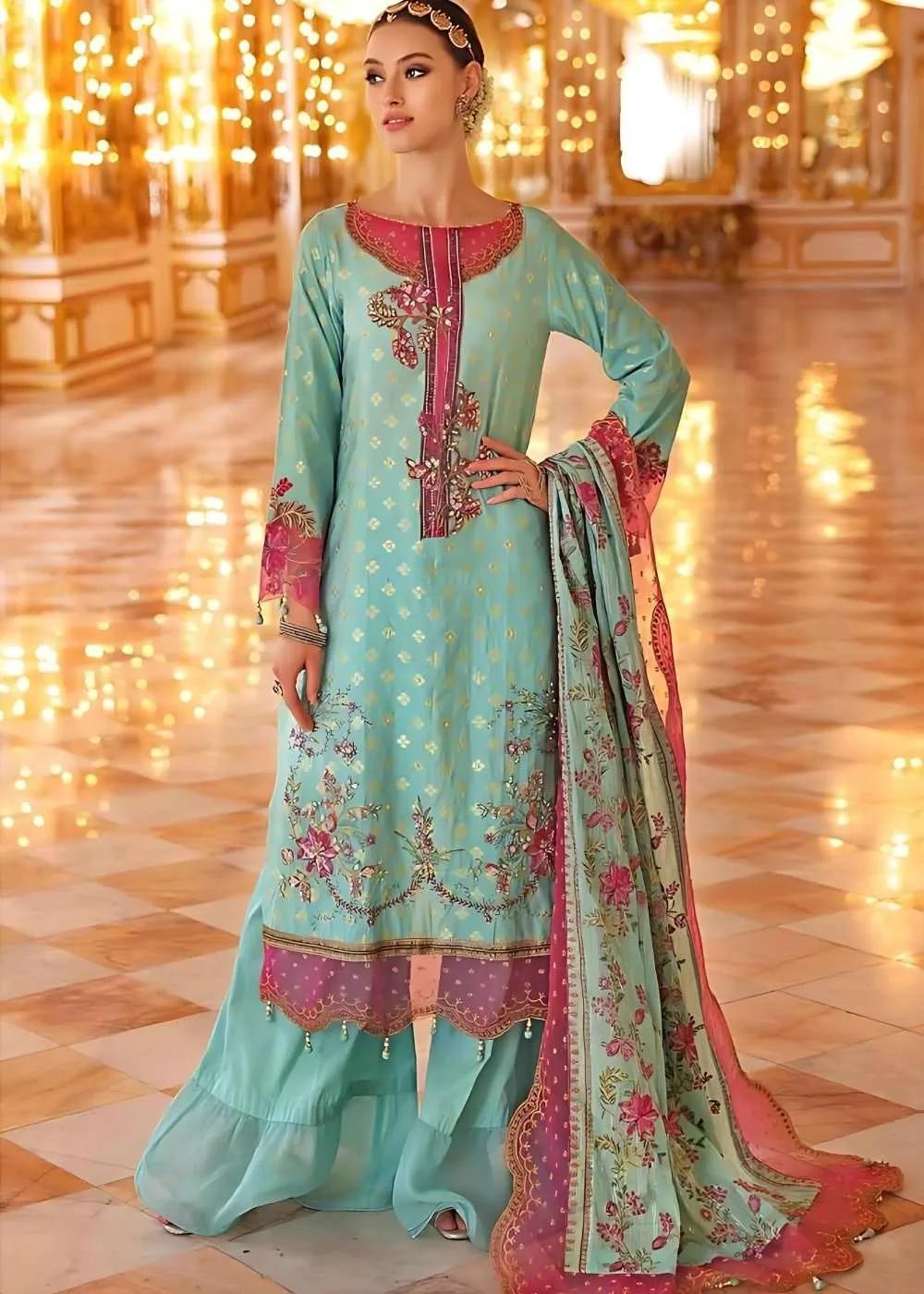
Gul Ahmed
Aqua Green Jacquard Embroidered Suit with Jacquard Dupatta – PRW-22002
Jacquard
Rs. 18,955Rs. 21,061
How to take and send accurate measurements
Most fit problems start at home with a loose tape or a rushed afternoon. Do this properly once.
- Ask a second person to measure you. Wear the undergarments and shoes you will wear on the day.
- Use a soft tape, held snug but not tight, and keep it level.
- Measure bust, waist, hip, shoulder, sleeve length, armhole, shirt length and trouser or lehenga length.
- Record in one unit only, inches or centimetres, and state which.
- Send a photo of your best-fitting existing outfit with its flat measurements as a cross-check.
- Ask the store to confirm your measurements back to you in writing before cutting.
If your weight may change before the wedding, say so and ask about extra seam allowance. Our shalwar kameez fit guide explains the measurements in more detail.
Shipping and customs basics
Customs rules, duty thresholds and VAT or sales tax differ by country and change over time, so we will not quote any. What you can do:
- Check your national customs or tax authority's website for rules on clothing imports and parcel values.
- Ask the courier who pays duty and whether you will be contacted before delivery.
- Make sure a phone number and a correct, complete address are on the order. Gulf addresses in particular can need clear landmarks.
- Keep the invoice. Customs may ask for it.
- Do not ask for a declared value that is not the real price. It can cause delays and problems.
Read our shipping policy for what we do and do not cover. Cash on delivery is available only inside Pakistan, so overseas orders are paid in advance.
Colour accuracy, fabric photos and questions to ask before you pay
Screens lie, especially with reds, maroons, golds and pastels. Ask for photos in daylight, near a window, with no filter. For embroidery, ask for a close-up so you can judge thread, sequin and zari work.
Before you pay, ask:
- What is the exact fabric of the shirt, dupatta and trouser?
- Is the outfit unstitched, ready-made or stitched to order?
- What is the current stitching time, and when will it ship?
- Will I see a photo before dispatch?
- What happens if the fit is off? See the return, exchange and refund policy.
Browse our Pakistani bridal dresses and formal dresses with those questions in hand.
What to do if the fit needs adjusting after delivery
Small alterations are normal for any fitted outfit. Try it on soon after it arrives, with the right shoes and undergarments, and take photos from the front, side and back.
- Contact the store quickly, with your photos and your original measurements.
- For minor changes, a local tailor can usually adjust hems, sleeves and side seams. This is why a seam allowance matters.
- Do not cut or unpick embroidery until you have spoken to the store.
Check the return policy before you order, as stitched-to-measure items are often treated differently from ready-made ones.
Wrapping up
A good Pakistani dress for marriage ordered from abroad comes down to three things: time buffers, careful measurements and clear answers before you pay. Start early, ask for photos, and keep everything in writing. If you would like help choosing fabrics or confirming measurements, contact our team in Karachi, or look at our guide for overseas Pakistanis.